Thursday, 26 April 2018

Street art of Lisbon


My son and I will never agree when graffiti becomes art, sometimes known as street art. Lisbon has a rich seam of street images to mine, all of the images in these photos I consider to be art. Anyone is free to make their own judgement. These images were all discovered by Lynne and myself purely by wandering about. where known I have mentioned the artist.
The Guardian newspaper recently voted Lisbon the best city for street art in the world. It is certainly true that art is everywhere. We loved it.


No known artists but the images can be found in the subway at Alcantara Mar.


Not really art but any skateboarder can see the story in this street furniture.


The fox is an example of the work of Bordalo II

He recycles, or should that be upcycles scrap materials to create marvellous 3d images

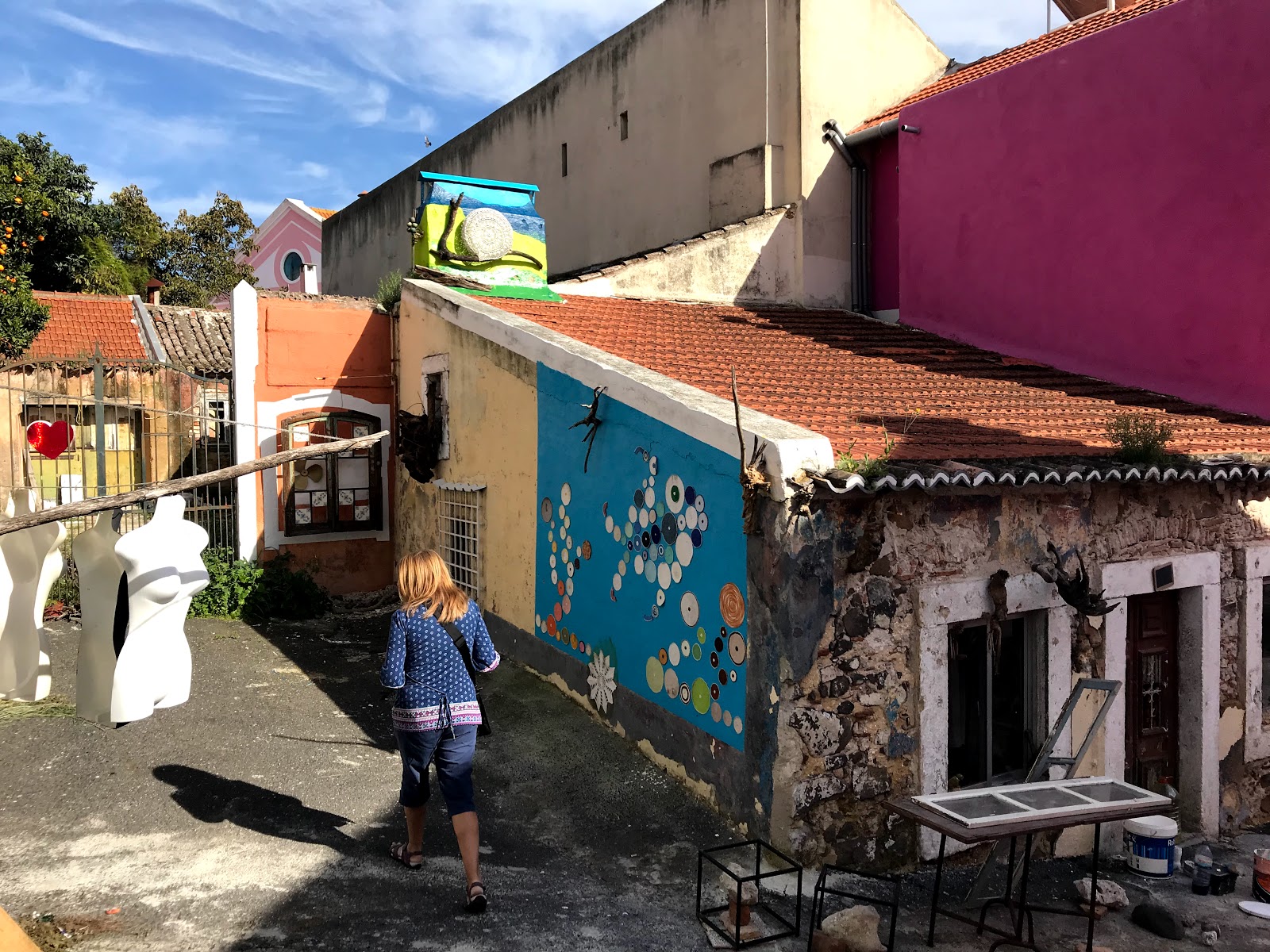
No known artist again but something we stumbled upon in the back streets of Belem.

 more Bordalo II close to Museo National de Azulejo.

We think that this is Bodalo IIs workshop


The MAAT building
Botanical gardens Belem (best seen from above....

Near the marina at Parque Nacoes an Anthony Gormley, possibly some bits left over from "another place"

You know who did this now don't you? 

A Henry Moore outside the Berado museum.

The symbol of Portugal is the cockerel, this one was at Martim Moniz square.


Artist not known Parque de Naceos, metal men....


Lisbon is a fascinating city, I strongly suspect it could eclipse London as an epicentre of the digital age. Apparently there are 4000 digital nomads resident at any one time. I wish it well.

Leaving Parque de Nacoes


Our home for over 6 months the Marina Parque de Nacoes at Lisbon. it was time to leave, the weather forcast was not great so I had decided on a small trip down and across the Tagus to Seixal, a small town up a winding but well bouyed creek.


I had been reading a History of the Jews by Simon Schama, a history incidentally where Lisbon features prominently and not always favourably, in fact its difficult to find anywhere on earth where Jews have not found discrimination and persecution.


I mention this because we anchored just off Seixal in the Canal do Judeu, (channel of the Jews )
I never did find out how it got its name. However a pretty place and a different feel to Lisbon even though it was only  a few miles away.


The tide started to fall and after the first night at anchor we awoke at low water to see men in the water by the boat up to their waists in the middle of the creek! Only a few metres away from us. We were afloat but the channel was narrow so to be on the safe side we picked up a vacant visitors mooring to assure ourselves we would not ground or scrape off our new antifouling paint.


The forecast winds would keep us here nearly a week, but it was a pleasant enough place and we were eager to explore, we blew up our dinghy and our outboard started first pull and we went ashore briefly that evening.

 There had been some redevelopment on the seafront and although this was definitely not a tourist place it was friendly and lively with a great deal of restaurants and other places to eat, seafood obviously.....


The buildings were old and slightly flaky but had a lot of charm. The local church was almost entirely tiled on its fascade and the bells on the quarter would be our constant companion for the next few days.


One of the marineros at the marina at Parque de Nascoes lived in Seixal and was most put out when we said we were only staying for two days, as it turned out we stayed longer and we are glad we did.


There was a pontoon which was full of large multihulls which did leave after a few days but we never felt it necessary to leave our mooring in the river. Dark Tarn can be seen in the distance in this photo from the town quay.


The tide fairly rattled through our moorings and we got used to the sight of the local fishermen walking past us riddling for cockles and other shellfish. The wind also continued to blow.


Museo National do Azulejo (part 2)


We were blown away by the Church of Madre de Deus and after we had got our breath back we continued to be delighted by the museum, B&Q it definitely wasn't!
There were full panels of the classic blue and white Azulejos


Along with more colourful panels usually of religious subjects but not always, some are rustic or humorous, but all are undeniably unique.


Not everything was tiles there were some fascinating art as well, this picture is renaissance and is a lovely example of religious historical art.


Some scraps of historical tiles had a personal significance, this particular tile is a portion of a world map showing Cumbria, the Solway firth Northern Ireland and the North channel, all places that Dark Tarn has voyaged herself.


There is a lot to see and as I previously mentioned there is a great deal of interactivity, not just the tactile elements for the blind but fun things for older kids too.


The old convent buildings have veen integrated well into the new purpose of the building.


The many cloisters help to separate the different periods of history and provide cool places to sit and think.

We gradually time travelled slowly towards the 19th and 20th century and colours returned as did some subtle humor.


Lynne is examining a panel where humans have been replaced by monkeys.


Certainly makes you think differently about grapes.....


Any opportunity to dress up and Lynnes in there!


One of the famous attractions of the museum is the Great Panorama of Lisbon, this huge Azulejo panel depicts Lisbon before the earthquake of 1755.


There is also an exhibition of art inspired by the panel.


As we know the city fairly well now we were fascinated by what had changed and what we still recognised in the cityscape. Below is the Torre de Belem (obviously it survived, not so obvious is that it used to be much further out in the Tagus )


Below is the Castle of St George rising over the city, the original not the copy that exists now. The Cathedral is also seen on the right.


Its fascinating to guess who the tiny people were and what their life must have been like not knowing that almost everything around them would be destroyed.


There is a lovely cafe to relax in (tiled obviously )


The tiles represent food as I believe the cafe now occupies the space that was previously the kitchens and refectory of the convent.


A fabulous day out and recommended for any visitor to Lisbon, a must see........


Museo National do Azulejo (part 1)


One of the places on Lynnes list of "must visit" was the Museo National de Azulejo, literally "Museum of tiles" , It is situated just outside the city centre, right on our local bus route into Lisbon.


I will be honest and admit I had no real idea what to expect, I didn't know if it would be more like B&Q than culture. I would be very pleasantly surprised.


The Museum is housed in an old convent. The Convento da Madre de Deus which was founded in 1509. The cloisters pictured above dates from this time.
The collections of tiles are displayed over 5 centuries of time through different areas and include Christian and Moorish tiles.


The museum is beautifully done and is totally accessible to people with disabilities. There are audio and tactile aids throughout along with the obvious ramps and lifts. No excuses for a 14th century building here! below is an example of a tactile aid panel.


We were immediately impressed as we looked at Moorish tiles and panels and were surprised by the fabulous colours being more used to the normal Portuguese Blue Azulejos.


However as we left the Galleries around the cloister we entered the Church of Madre de Deus and it literally takes your breath away.........


The initial entrance hall is a riotous splash of tiles and oil paintings, however the main body of the church is  with the exception of some blue Azulejo panels covered floor to ceiling in oil paintings and gilded decoration. The Rococo altarpiece was added after the earthquake in 1755.


Now we have become a bit jaded about sumptuous decoration in churches in the Iberian peninsular, but this one really is a bit special.


The quality of the painting is astonishing as we walked about ( getting stiff necks ) in the nave we spotted a window high above the entrance that was an indication where the nuns chapel was located.
Above and out of sight of the main congregation.


Later we discovered the entrance to the Nuns side chapel on the floor above and accessed from a beautiful ant-room again decorated in Blue Azulejos and oil paintings, there were some lovely wooden lecterns and a ceramic collection of nativity figures.


You really have to see and study them closely to see the wonderful character in the features and marvellous craftsmanship. I don't think we have seen anything similar outside Portugal.


The side chapel itself is another breathtaker. The floor is made from an exotic south African hardwood and you are informed in no uncertain terms to stay on the carpet!
Quite difficult to walk and look up, and look you must..........


Each Pew has its own reliquary above it as you walk the length (on the carpet ) of the chapel the view back down into the main body of the church gives another view of the wonders below.


This is a photo of one of the reliquarys. they are behind every pew and below the many paintings.


I will finish this part with a small video which may give a flavour of our visit. I will continue with the main body of the museum in part 2.