A little bit of yachting folklore, the Guadiana is a place that yachties come to shelter, winter over and seemingly take root for years. I have always wondered what the attraction was and only after coming here myself do I think I begin to understand. There is not a lot of development on the banks. The twin towns of Sanlucar de Guadiana and Alcoutim sit facing each other across the river and indeed border.
In the time of Brexit I am reminded that these two towns, if you had been standing on either bank from 1966 to 1976, allowed no contact between the two .Of course people being people contact continued, a tradition of cooperation hundreds of years old was forced into secrecy and smuggling. To all intents and purposes now the border is invisible and the only raised voices to be heard are people shouting and whistling for the ferries. We move seamlessly from one country to another, at no time are we in any doubt which country are we in and given the history between the two this is an astonishing and wonderful miracle.

I suppose no less miraculous than a community that provides shade for ducks. This is the small beach area in Sanlucar.
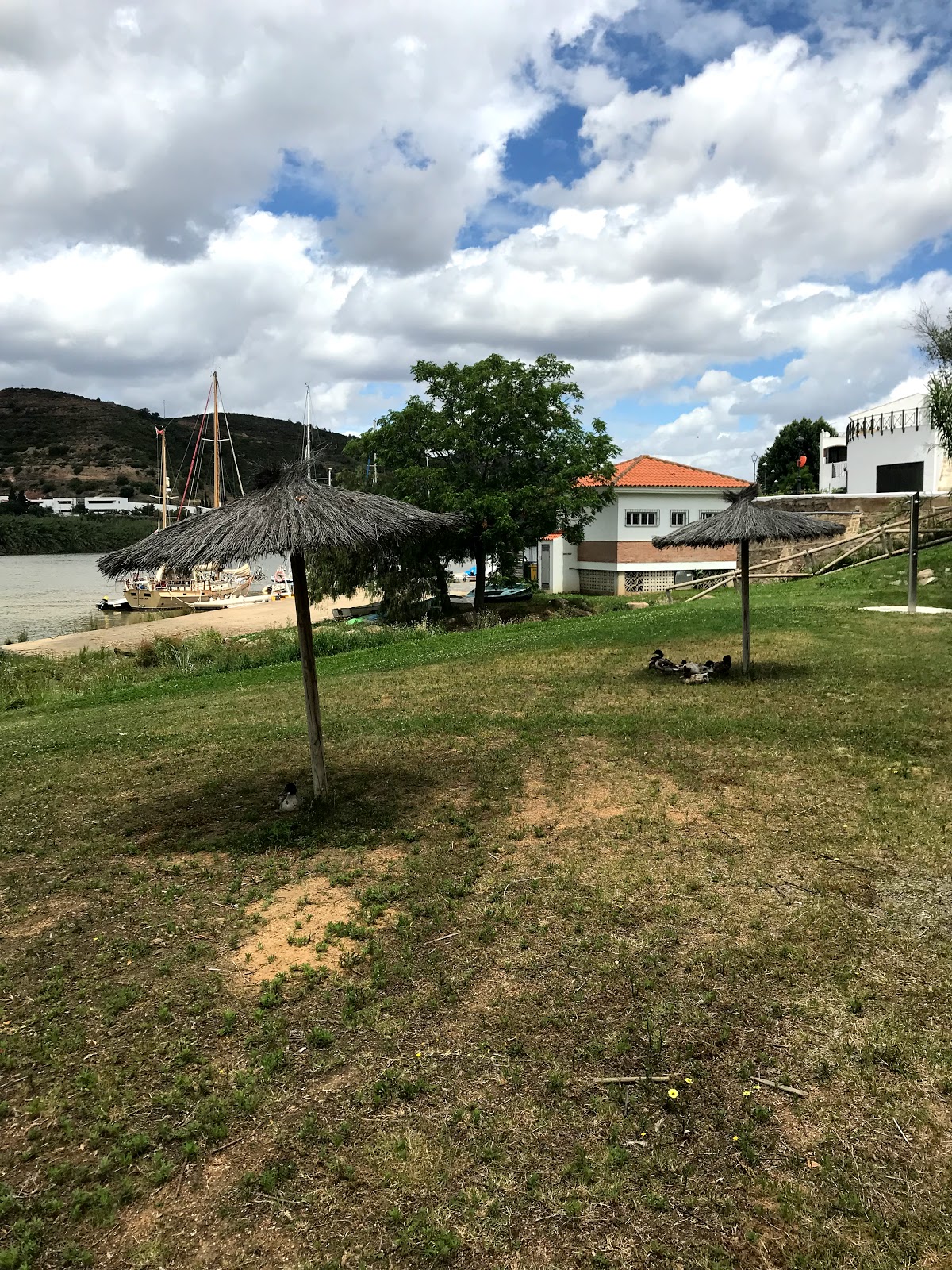
We would later discover the river beach in Alcoutim, (blue flag ) I understand that there is now a lot of co-operation between the two communities, on an official level, rather than the illegal cross contamination of the recent past. However in this particular Alcoutim has it. But I would hesitate to swim in either.

There is a small bathing area and almost unique on the Algarve it provides showers. Something we have become used to everywhere else and were very surprised by its absence on the tourist Algarve.

But it was nice to see the local wildlife taking advantage of the facilities.

The architecture on both sides of the river is becoming more characteristic of Andalusia, whitewashed walls and tiled roofs, it is a very attractive style. There is a profusion of public art and appreciation which tends to accent local artists, characters, historical events and celebrations.
From the sculpture of the above local artist we ascended the winding streets to the Church on the hill.

Its always on a hill, unfortunately the church is largely closed as the local priest has to spread himself very thin across three parishes and is only open (for services) maybe once or twice a week.

Its a beautiful, classically Spanish building. It has a couple of points of interest outside, one of which is the statue celebrating a local flower festival.

One other is a simple crucifix, shown in the photo below along with the windmills on the hill in the background. They are a skyline feature visible from many places in the town.

We were however totally perplexed by this miniature door we discovered built into a wall. It obviously is part of a representation of a windmill but for the life of us, we cant understand why?
Charming none the less.

As we have come to expect public amenities in Spain and Portugal are well financed and fairly ubiquitous, a case in point being Sanlucars Fountain/Well/ children's play area/ boules pitch/ just generally nice place to sit...…..under the windmills.....

There is a cafe bar at one end, El Pozo, very popular with locals for dining.

As we had already eaten on this particular occasion we wandered towards he upstream end of town and discovered the cemetery.

As if we needed reminding , we are back in Spain. The dead are very much alive.
We walked back into the town towards the river front and passed a lovely building with some unusual roof tiles. Someone somewhere has thought, "we need to decorate the underneath of those roof tiles".
Sir, I salute you.....

Here is the complete building, a masterpiece of understated elegance. God is in the detail, I cant remember who said that, I think it was a scientist, but it is absolutely true.

Meanwhile back on the pontoon the squirrely weather was throwing black clouds across the sky, so we decided a visit across the river to Portugal might be in order.

One of the first things you encounter visiting Alcoutim, leaving the pontoons, is this statue. It represents a smuggler. It is one of a trilogy the other two being the fisherman, to be found near the chapel of St Antonio, and the Fiscal guard who can be discovered looking down from a cafe overlooking the quay.

The view back across the river to Sanlucar shows the dominant castle (Moorish ) above the town.

It really is a most attractive spot. Dark Tarn can be seen in the photo nestled against the pontoon.

The water taxis are the two squarish looking craft with Bimini's on the Portuguese side.

It may have been an illusion but the weather seemed to pick up as we wandered the streets heading vaguely towards the Castle. This dates from the reign of king Dinis, in the 1300s.

The interior is a well kept garden area and steps lead up onto the battlements which enable you to appreciate the views over the river.

However there is also a fascinating museum of archeology to be seen.

This is enclosed within a purpose made building and represents a "dig" that it is possible to wander over and through using raised glass walkways.

There are explanations of exhibits, both on plaques (in Portuguese ) or in a handy book that is available on entrance. There have been fortifications on this site since the Romans and the various layers of history are exposed to view.

The Iberian fascination with cage birds continues to surprise us, there is a small aviary on the "Esplanade".

It was nice to be able to look back across the river to Sanlucar, later in the week we would return here for a picnic lunch. your ticket to enter the castle lasts a week.

Lynne seems now to have no fear of walking battlements, there was of course a sensible handrail provided on this occasion!


After the castle we returned to the river front to find the last sculpture, he is to be seen on the balcony in the photo below. We enjoyed a coffee before ticking of our last challenge. To discover the inland beach.

There is a small tributary river the Cadavais that joins the Guadiana at Alcutim. Here you can find the Pego Fundo beach. its a remarkable stretch of golden sand and apparently in 2003 was the only inland beach in Portugal to be awarded a blue flag. We had arrived just before they put up the shady beach parasols.

On returning back towards the village we discovered this great outdoor art gallery of Azulejo tiled panels, of course if you stopped for any length of time to admire them you ran the risk of being run over!

The following day we climbed to the windmills overlooking Sanlucar.

The views were now back towards Alcutim and Portugal.

And also the Moorish castle overlooking Sanlucar.

we deviated from the established path to discover an unrestored Mollinos de Viento hidden in thick woods.

The millstone rather gave the game away as to its history. Later we descended to enjoy a drink in the other bar in town. El Pozo. We had decided we really needed to eat here before we left.

That evening from the bar near the river we enjoyed a fabulous sunset and we hoped it foretold the end of the cloudy weather.

The following day our friends Jim and Megan aboard Magnet had come up river from Ayamonte, under the bridge of doom and had anchored a bit downstream of the two towns.

We met up and enjoyed a curry in the Indian restaurant in Alcutim. It was lovely to see them both again after parting company over a year ago in the Rias of Galicia.


